
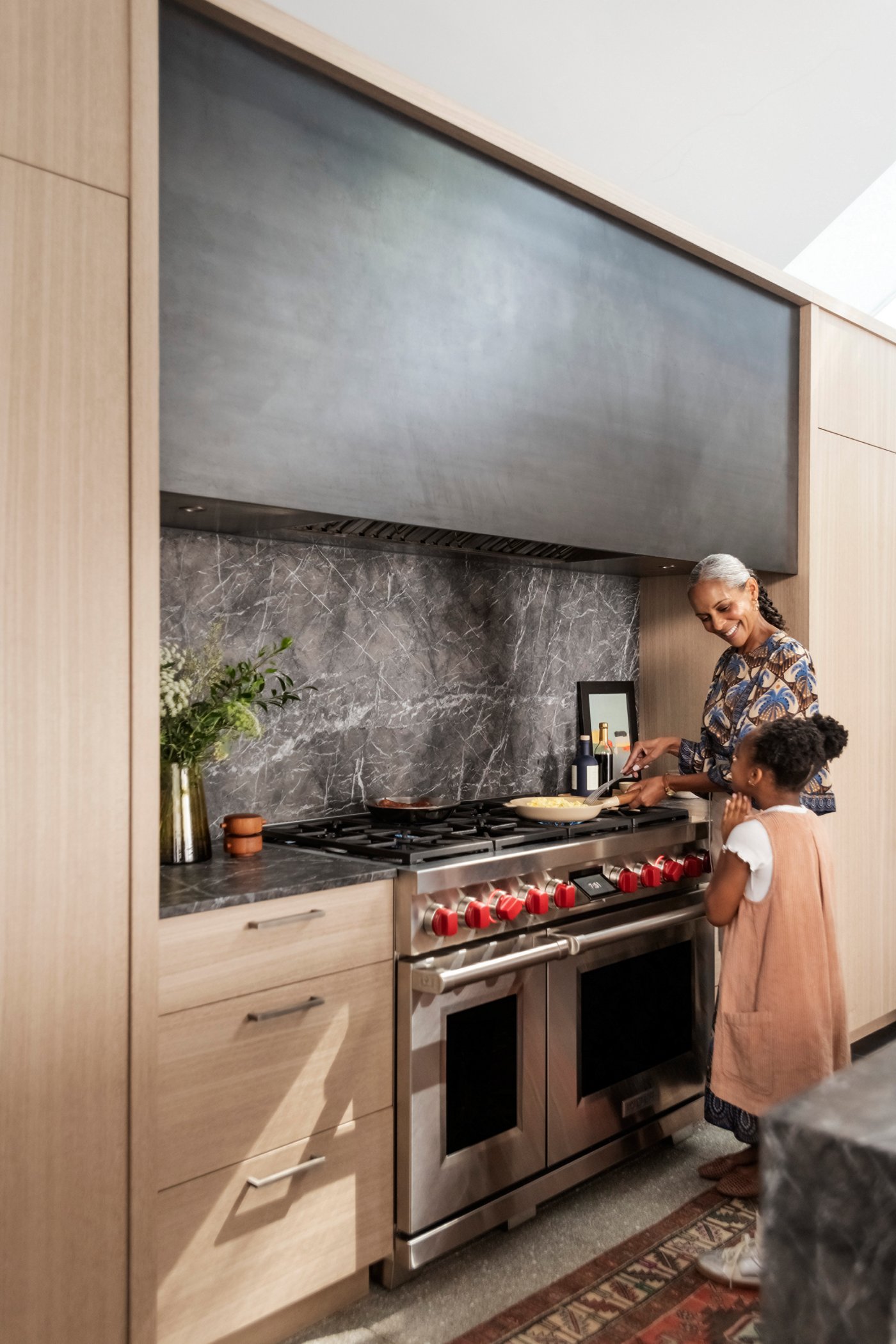
When choosing a Wolf professional range, one of the most fundamental decisions is the fuel configuration: dual fuel (gas cooktop, electric convection oven) or all-gas (gas cooktop, gas oven). Both configurations are available in all Wolf range widths — 30″, 36″, 48″, and 60″ — and at the same price points within each width category. Both deliver Wolf’s signature cooktop performance. The distinction is entirely in the oven, and understanding that distinction clearly helps you make the right choice for your cooking style and kitchen setup.
The Cooktop: Identical in Both Configurations
Before discussing oven differences, it is important to understand what does not change between Wolf dual fuel and all-gas ranges: the cooktop. Both configurations use the exact same Wolf dual-stacked sealed burner system — the same burner BTU ratings, the same precision simmer capability, the same grate and burner cap design, and the same ignition system.
Wolf’s largest dual-stacked star burner delivers 20,000 BTU for high-heat searing and rapid boiling in both configurations. The ultra-low simmer mode delivers 300 BTU for the most delicate sauce maintenance and chocolate melting. The choice between dual fuel and all-gas has no bearing on cooktop performance. Your decision should be driven entirely by oven considerations.
The Dual-Fuel Oven: Electric Convection Precision
Wolf dual fuel ranges (DF series) use a true electric convection oven — heating entirely from electric resistance elements rather than a gas burner. The electric convection system in Wolf DF series ranges is a full professional oven with a dedicated bake element, broil element, and convection element combined with a dual-speed convection fan.
Key advantages of the Wolf dual-fuel electric oven:
- Superior temperature accuracy. Electric resistance elements are inherently more precise than gas burner heating. The control board modulates electric element power in small increments, maintaining oven temperature within a very tight band around the set point. Gas ovens cycle their burner on and off, creating wider temperature swings.
- Faster temperature recovery. When you open the oven door and heat escapes, an electric convection oven returns to set temperature faster because the convection fan continues circulating heat and the electric elements respond immediately to the temperature drop.
- Drier oven environment. Electric ovens produce no combustion byproducts — the oven air is dry. This is particularly important for bread crusts, pastry browning, and any baked goods where moisture control affects the final texture.
- More intense broiling. The electric broil element in Wolf dual-fuel ranges produces more focused, intense radiant heat than the gas broiler in an all-gas Wolf range. Searing and browning under the broiler is more aggressive in the dual-fuel configuration.
- More cooking modes. Wolf DF series ranges typically offer 10 or more oven cooking modes enabled by the combination of multiple electric elements and the convection fan, including Bake, Convection Bake, Convection Roast, Broil, Convection Broil, Roast, Proof, Dehydrate, and others depending on the specific model.
The dual-fuel Wolf range is widely considered the superior choice for serious bakers. The combination of electric heat precision, fast temperature recovery, and dry oven environment produces more consistent, reproducible results in baked goods — particularly in pastries, croissants, bread, and anything where precise, stable oven temperature over a long baking period is critical. Many professional pastry chefs specifically choose electric ovens for exactly this reason.
The All-Gas Oven: Traditional Performance, Simpler Installation
Wolf all-gas ranges (GR series) use a gas-fired oven with a gas bake burner, a gas broil burner, and a convection fan for convection modes. The all-gas Wolf oven delivers excellent cooking performance that the vast majority of home cooks will find indistinguishable from the dual-fuel configuration in everyday cooking.
Key advantages of the Wolf all-gas oven:
- Simpler installation. An all-gas range requires only a gas line at the range location — no 240V electrical connection is needed beyond the standard 120V outlet already required for ignition electronics and the convection fan. If your kitchen does not have a 240V electrical connection at the range position, the all-gas configuration avoids a potentially significant electrical installation cost.
- Moist oven environment. Gas combustion produces water vapor as a byproduct, creating a slightly more humid environment inside the oven cavity. Many experienced roasters prefer this for large cuts of meat — the ambient moisture can contribute to a juicier result during long roasting sessions.
- Operation during power outages. A gas oven can be lit manually during a power outage, allowing you to cook when electric power is unavailable. A dual-fuel range’s oven is completely inoperable without electrical power — the electric elements require the 240V supply.
- Same cooktop performance. Identical dual-stacked sealed burner system to the dual-fuel models — no compromise on cooktop BTU output or simmer precision.
Installation Considerations
The most practical distinction between dual fuel and all-gas Wolf ranges for many buyers is the installation requirement:
- Dual fuel requires a 240V electrical circuit. The Wolf dual-fuel range requires a dedicated 240V circuit — typically a 50-amp circuit — at the range location in addition to the gas line. If your kitchen previously had a gas range, there is likely a gas connection but no 240V outlet at the range position. Installing a new 240V circuit typically costs $300–$800 depending on your electrical panel’s proximity to the kitchen. Factor this into your total installation budget.
- All-gas requires gas line only. If your kitchen has an existing gas range, the all-gas Wolf range installs directly — no additional electrical work is required beyond the standard 120V outlet already present for the existing appliances.
- Both require professional installation. Neither configuration should be self-installed. Wolf range installation involves gas line connection, leveling, anti-tip device installation, and electrical connections — all performed by licensed tradespeople to maintain the Wolf warranty.
Baking Performance Comparison
For most general cooking — roasting vegetables, cooking casseroles, reheating, preparing pizza — the Wolf all-gas oven performs excellently and most users will not notice a meaningful difference from the dual-fuel configuration.
The gap between dual fuel and all-gas baking performance becomes most apparent in precision pastry work, croissants, delicate cakes, souffles, and bread baking where temperature consistency over long baking periods is critical. In these applications, the electric oven’s tighter temperature regulation and faster recovery produce more consistent, reproducible results.
If baking represents a significant portion of your cooking — and particularly if you bake pastries, bread, or anything requiring precise temperature control — the dual-fuel configuration’s electric oven is a meaningful upgrade. If your oven use is primarily roasting and general cooking, the all-gas Wolf range represents no meaningful compromise.
Service Considerations for Both Configurations
From a long-term service perspective, both dual fuel and all-gas Wolf ranges use the same ERC (Electronic Range Control) fault code architecture — F1 through F15 apply to both configurations. Dual-fuel ranges have the bake element and broil element as additional potential service components that all-gas ranges do not have, but the gas-fired oven has the gas igniter and gas safety valve as service items not present in the electric oven. Both configurations share the same cooktop components and the same ERC control system, so the majority of service procedures are identical between configurations.
Our technicians service both Wolf dual-fuel and all-gas ranges across the full lineup from 30″ to 60″. View our Wolf range repair service or book a service appointment.
Need a Wolf Appliance Repair?
Same-day service · Certified Wolf technicians · 30-day warranty on every repair.