
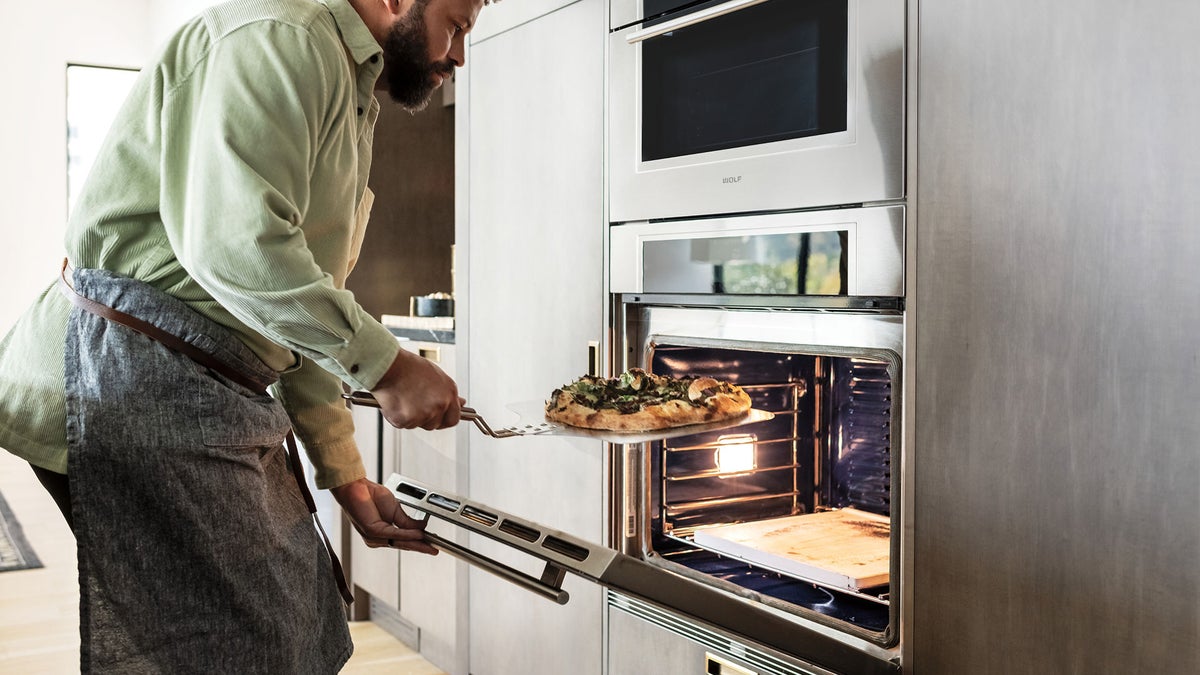
Wolf ranges, wall ovens, and convection steam ovens use the Electronic Range Control (ERC) fault code system to communicate specific component failures through the control panel display. When an F-code appears, it is not a generic warning — it is a precise diagnostic message that identifies the failed or malfunctioning component. Understanding what each code means helps you know how urgently a repair is needed, whether it is safe to continue using the appliance, and what to tell your technician when you call for service.
This guide covers the complete Wolf oven F-code series from F0 through F15, with practical explanations of what each code indicates and what your immediate action should be.
F0 — ERC Initialization or EEPROM Failure
F0 appears when the Electronic Range Control board fails to complete its startup initialization sequence after power is restored. This can be caused by a power surge corrupting the ERC non-volatile memory (EEPROM), or by an age-related component failure on the control board itself. The range will not operate until the ERC successfully initializes.
What to do: Switch off the range circuit breaker for 60 seconds and restore power. Allow the control panel to complete its startup sequence before testing any functions. If F0 clears and the range operates normally, monitor for recurrence. If F0 returns after every power cycle, the ERC board requires professional replacement — the EEPROM chip has failed and cannot be field-repaired.
F1 — ERC Control Board Internal Failure
F1 is the fundamental ERC fault code — it indicates the control board itself has detected an internal component failure. Unlike codes that identify a specific peripheral (sensor, fan, door lock), F1 means the brain of the oven has a problem. F1 is often triggered by a power surge, by age-related capacitor or relay failure on the ERC board, or by heat cycling degrading the board over years of use.
An unstable control board with an intermittent F1 can cause unpredictable oven behavior — do not continue regular use with a recurring F1 code.
What to do: Reset at the circuit breaker for 60 seconds. If F1 clears and the range operates normally through several uses, the issue may have been a transient voltage event. If F1 returns on first use or consistently after power cycles, the ERC board requires professional replacement.
F2 — Oven Temperature Sensor Shorted
F2 indicates the oven temperature sensor (RTD probe) inside the oven cavity is reading resistance below the minimum acceptable threshold — the circuit is effectively shorted. The RTD probe measures temperature by changing its electrical resistance as temperature changes. A shorted probe reads an artificially low resistance, causing the control board to detect a hardware fault and shut the oven down as a safety measure.
F2 is one of the most common Wolf oven fault codes. In the majority of cases, the RTD probe itself has failed with an internal short, and probe replacement resolves the fault completely. Less commonly, the wiring between the probe and the control board has developed a short along its run through the oven cavity.
What to do: Do not use the oven with an active F2. Without reliable temperature sensing, the control board cannot regulate temperature safely. Schedule professional repair — Wolf OEM RTD probes are model-specific and should be replaced with genuine parts to ensure correct temperature calibration after replacement.
F3 — Oven Temperature Sensor Open Circuit
F3 is the mirror of F2. Where F2 indicates the sensor circuit is reading too low (shorted), F3 indicates the circuit is reading too high or infinite resistance (open circuit). The RTD probe element has broken internally, the wiring connector at the sensor or ERC has come loose, or the wire has broken somewhere along its run. The control board cannot obtain a temperature reading and disables oven heating.
F3 and F2 are clinically different fault conditions but are repaired in the same way — the sensor probe is the most likely failed component in both cases. A technician measures probe resistance to confirm whether the probe, connector, or wiring harness is the fault location.
What to do: Same as F2 — do not use the oven and schedule professional service. RTD probe replacement is typically the resolution for F3.
F4 — Oven Temperature Runaway
F4 is among the most serious Wolf oven fault codes. It triggers when the oven temperature exceeds the set point by more than the control board’s acceptable threshold — the oven was heating uncontrollably past the programmed temperature. The most common cause is a stuck oven relay on the ERC: the relay that cycles the heating element on and off has failed in the permanently closed position, keeping the element continuously energized regardless of the control board’s commands.
F4 can also be caused by a failed temperature sensor reporting a falsely low temperature, causing the control board to continue heating well past the set point before the overtemperature threshold is reached.
What to do: Do not use the oven. F4 is a safety-critical fault — a stuck relay can cause dangerous oven overheating, potential food safety issues, and fire risk. Schedule emergency professional repair. This typically requires ERC control board replacement, as the relay is integral to the board on most Wolf ERC configurations.
F5 — Door Latch Motor Timeout (Latch Cycle)
F5 appears when initiating a self-clean cycle and the door latch motor fails to complete the latch cycle within the ERC-allowed time window. The oven cannot begin self-clean until the door is confirmed locked — F5 means that confirmation never came. The door may lock in position during the fault, or may remain unlocked depending on how far the latch motor traveled before timing out.
What to do: If the door has locked, do not force it. Switch off the circuit breaker for 5 full minutes — longer than the standard 60 seconds — then restore power. The latch motor should reset to the home (unlocked) position on startup. If the door unlocks, you can use the oven normally but should schedule service before attempting self-clean again. If the door remains locked after the 5-minute reset, call a technician immediately.
F6 — Door Latch Thermal Limiter Opened
F6 indicates the one-time thermal limiter inside the door lock assembly has opened. This non-resettable thermal fuse is designed to protect the latch motor from heat damage during self-clean cycles. Once it opens, it cannot be reset — the part must be replaced. The self-clean function is unavailable until the thermal limiter is professionally replaced. Standard baking and broiling are typically unaffected by F6.
What to do: Do not attempt further self-clean cycles until the thermal limiter has been replaced. Schedule a non-urgent professional repair — this is a single-part replacement that a technician can complete in under an hour.
F7 — Keypad Input Stuck or Shorted
F7 indicates the ERC has detected a keypad control input registering as continuously pressed. This is commonly caused by moisture (steam or spill liquid) that has entered the membrane keypad and created a conductive short on a switch contact. Physical damage to the control panel can also cause F7. The fault is one of the more common Wolf oven codes in busy kitchens where steam exposure to the control panel is frequent.
What to do: Switch off the circuit breaker for 60 seconds. If the fault occurred after steam or liquid contacted the control panel, allow the panel to dry for a full 24 hours before restoring power. If F7 clears and does not return, the fault was moisture-related and may not recur. If F7 returns consistently after thorough drying, the keypad membrane or touch control PCB requires replacement.
F8 — Relay Board Fault or Broil Element Circuit
F8 indicates a fault in the relay board or broil element relay circuit. On dual-fuel and larger Wolf range configurations, a dedicated relay board controls the high-current heating elements. F8 signals an unexpected open or fault in this circuit — commonly a failed relay on the board or a shorted broil element. Broil mode will typically be unavailable with an active F8 fault.
What to do: Reset at the circuit breaker. If F8 returns, avoid broil mode and schedule professional service. Standard bake may remain available if the fault is isolated to the broil circuit — but have the relay board inspected promptly, as a stuck relay presents an overheating risk.
F9 — Door Latch Motor Timeout (Unlatch Cycle)
F9 is the counterpart to F5. Where F5 appears when the door fails to latch at the start of self-clean, F9 appears when the door fails to unlatch at the end. The door may remain locked after the self-clean cycle completes. F9 involves the same door lock motor assembly as F5 and is repaired identically — the motor assembly has failed and cannot complete the unlatch travel cycle.
What to do: Switch off the circuit breaker for 5 full minutes and restore power. If the door unlocks, schedule service before running self-clean again. If the door remains locked, call for immediate professional service — do not force the latch mechanism under any circumstances.
F10 — ERC Control Cavity Overtemperature
F10 triggers when the area around the control board has exceeded its safe operating temperature, causing the ERC thermal protection to activate. This is typically caused by insufficient ventilation clearances above or around the range, or by a failed control cavity cooling fan on models with active cooling. F10 is a protective shutdown — the range disables before heat damage to the ERC occurs.
What to do: Power off the range and allow it to cool for 30–60 minutes. Verify that the installation clearances above and around the range meet Wolf specifications. If F10 returns after a full cool-down and verified clearances, a professional evaluation of the ERC thermal limiter and cooling fan is required.
F11 and F12 — Dual-Oven Communication and Module Faults
F11 applies to dual-oven range configurations and indicates a communication fault between the primary and secondary ERC modules — the data bus between the two oven cavities’ control boards has lost synchronization. F12 indicates a fault specific to the lower oven ERC sub-module. Both codes typically disable the affected oven cavity and require specialist dual-oven diagnosis and professional ERC module replacement.
What to do: Reset at the circuit breaker. F11 and F12 that return after reset require professional diagnosis of both ERC modules and their interconnecting wiring. Do not use either oven cavity until F11 has been professionally diagnosed — a communication fault can cause erratic temperature control even in the apparently functioning cavity.
F13 and F14 — Convection Fan Faults
F13 indicates the convection fan motor circuit has faulted — the fan does not rotate or draws excessive current when convection mode is initiated. Convection modes are disabled, but standard bake and broil remain available. F14 indicates the convection fan speed sensor is detecting rotation outside the acceptable range — the fan is running but at incorrect speed due to worn motor bearings or an erratic speed sensor signal.
What to do: Reset at the circuit breaker. If F13 or F14 returns, standard bake and broil modes remain safe to use. Avoid all convection modes until the fan motor or speed sensor has been professionally repaired.
F15 — ERC EEPROM Memory Checksum Error
F15 indicates the ERC has detected a checksum error in its EEPROM non-volatile memory — stored configuration data, calibration values, or program data has been corrupted by a power surge or chip failure. Custom temperature calibration offsets and user settings stored in EEPROM may be lost. The ERC may revert to factory defaults.
What to do: Reset at the circuit breaker. If F15 clears, re-enter any custom temperature calibration offsets through the range control settings menu. If F15 returns consistently, the ERC board requires professional replacement — EEPROM chip repair is not feasible in the field.
Browse our complete Wolf fault code reference library or book a repair appointment with same-day availability.
Need a Wolf Appliance Repair?
Same-day service · Certified Wolf technicians · 30-day warranty on every repair.