
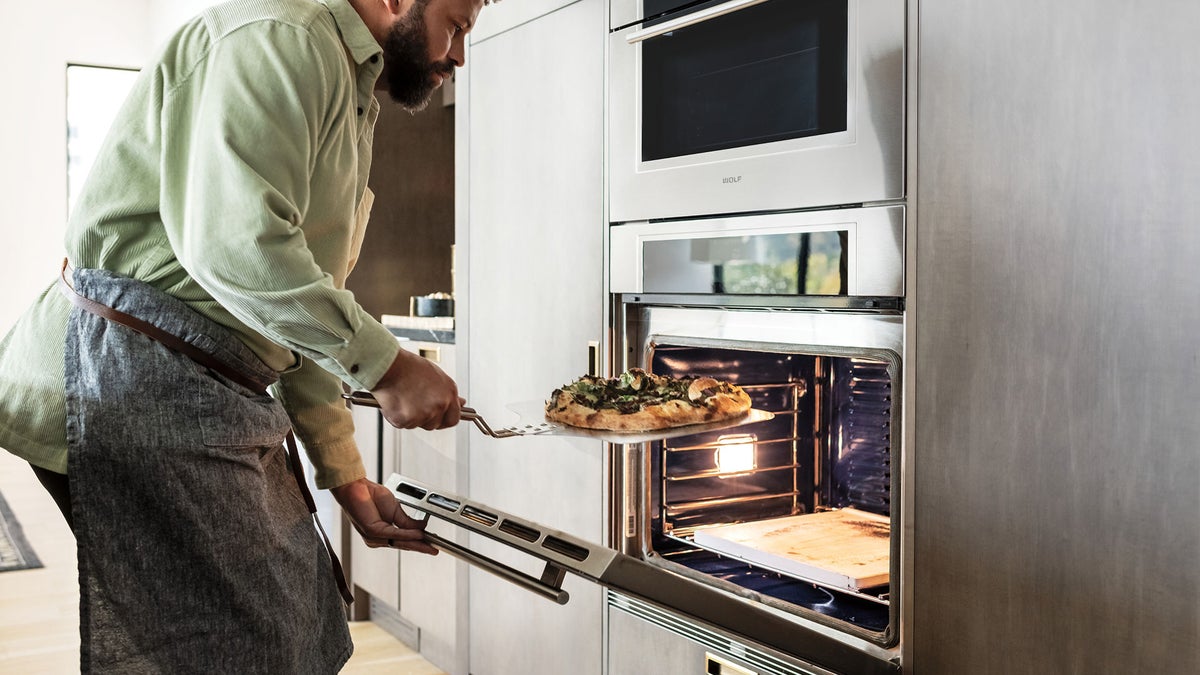
A Wolf wall oven that refuses to heat is one of the more alarming appliance failures in a Wolf kitchen — wall ovens are built into permanent cabinetry and cannot simply be moved to a counter for a quick repair. When your Wolf E Series or M Series wall oven stops heating, understanding the most likely causes helps you communicate effectively with your service technician, set accurate expectations for the repair timeline, and know whether the oven can be safely used in any mode while you wait for the repair appointment.
1. Active Fault Code on the Control Panel
The first thing to check when your Wolf wall oven stops heating is the control panel display. Wolf wall ovens use the same ERC (Electronic Range Control) fault code system as Wolf ranges — F1 through F15 appear on the display and directly identify the failed component or system. If an F-code is displayed, the oven has already diagnosed itself.
The most common codes associated with no-heat conditions in Wolf wall ovens:
- F2: Oven temperature sensor shorted — the RTD probe is reading below minimum resistance. Heating is disabled as a safety measure. Sensor replacement resolves this in most cases.
- F3: Oven temperature sensor open circuit — the probe has broken internally or is disconnected. Heating is disabled.
- F4: Temperature runaway — the oven previously exceeded the safe temperature limit. Safety-critical fault. Do not use the oven until professionally repaired.
- F1: ERC control board internal fault — the control board itself has failed. All oven functions are disabled.
- F8: Relay board fault or broil element circuit fault — may disable broil mode or, if the main bake relay has failed, all heating.
What to do: Switch off the circuit breaker for 60 seconds, restore power, and observe whether the fault code returns. If it returns after the reset, the diagnosed component requires professional replacement. Do not attempt to use the oven with an active F4 — this is a safety fault with overheating risk.
2. Failed Bake Element
In Wolf E Series and M Series wall ovens — which are all electric — the bake element is the lower heating element in the oven cavity. It provides the primary heat used in Bake mode and contributes bottom heat in Convection Bake mode. Bake element failure is the most common hardware cause of complete oven no-heat in Wolf wall ovens.
Elements fail in two ways: visible failure (a physical break, crack, or burn mark is visible in the element coil) and internal failure (the element appears physically intact but has broken internally and reads open circuit on a multimeter).
How to check: With the oven cooled and powered off, remove the oven racks and inspect the bake element at the bottom of the oven cavity. Look for any visible break, blistering, or burn marks. If the element appears visually intact, set the oven to Bake and observe through the oven window — a functioning bake element will begin glowing red-orange within 1–2 minutes. If it stays dark and cold, it has failed internally.
What to do: Bake element replacement is a professional repair using a Wolf OEM element matched to the specific wall oven model. Our technicians complete bake element replacements on the first visit for most Wolf wall oven models.
3. Failed Broil Element
If the Wolf wall oven heats in Bake mode but not in Broil mode, the broil element (upper element) has failed. Unlike a total no-heat condition, a failed broil element allows most cooking modes to continue — only broiling and convection broil are unavailable. Some Wolf wall oven firmware versions trigger an F8 fault code when the broil circuit detects a fault — if F8 is displayed alongside a no-broil condition, the fault code confirms the diagnosis.
What to do: Broil element replacement is a professional repair. Until the element is replaced, avoid broil and convection broil modes. Bake, Convection Bake, Convection Roast, and other modes that do not require the broil element remain safe to use.
4. Failed Oven Temperature Sensor
The oven temperature sensor — the RTD probe mounted on the back wall of the oven cavity — reports oven temperature to the control board for regulation. When this sensor fails, the control board either receives an invalid reading and disables heating (triggering F2 or F3), or receives a drifted reading that causes the oven to heat incorrectly — shutting off before reaching set temperature or cycling erratically.
Temperature sensor failure is among the most common Wolf wall oven hardware faults. Sensors are subject to years of thermal cycling in a high-heat environment, and in steam-adjacent installations (wall oven installed near a Wolf CSO), accelerated sensor corrosion from moisture exposure is a recognized failure mode.
How to check: A technician measures sensor resistance with a multimeter. The Wolf OEM RTD sensor for most E Series and M Series wall ovens reads approximately 1,080–1,090 ohms at room temperature. Readings significantly outside this range indicate sensor failure. Note that a drifting sensor may not trigger a fault code — it may simply cause the oven to heat to the wrong temperature without displaying an error.
What to do: Schedule professional sensor replacement. Wolf OEM sensors are model-specific — use genuine Wolf replacement sensors to ensure correct temperature calibration.
5. ERC Control Board Failure
The ERC board is the electronic brain of the Wolf wall oven, managing all temperature regulation, mode selection, timing, and safety functions. When the ERC fails — from a power surge, age-related component failure, or heat cycling — all oven functions become unavailable. F1 is the fault code most directly associated with ERC failure.
On double wall oven models (DO30, DO36), each oven cavity has its own ERC module — failure in one module typically affects only that cavity, though F11 or F12 may appear indicating inter-module communication issues. ERC board failure is less common than sensor or element failure as a cause of no-heat conditions, but it is the most expensive single-component oven repair.
What to do: If F1 is displayed and returns after a 60-second breaker reset, ERC board replacement is required. Our technicians confirm ERC failure definitively using diagnostic procedures that rule out peripheral component faults before recommending board replacement — we always confirm the board is the fault source before ordering it.
6. Loss of 240V Supply to the Oven
Wolf wall ovens require a 240V electrical connection for element operation. If the 240V circuit has partially failed — a common issue in older homes where one leg of the 240V supply has tripped or failed — the oven may have power for the control panel and display (which runs on 120V) but no element heating (which requires both 240V legs).
This presents as a confusing symptom: the oven turns on, the display functions, the fan may run, but the oven does not heat at all — and no fault code is displayed because the control board is receiving 120V power and functioning normally.
How to check: If your Wolf wall oven displays normally and responds to control inputs but produces absolutely no heat after several minutes in Bake mode, loss of 240V is a possible cause. Check the circuit breaker panel for a tripped breaker. If the breaker appears set but the issue persists, a licensed electrician should test voltage at the oven’s junction box.
What to do: 240V electrical supply issues require a licensed electrician. Our technicians can confirm whether the oven is receiving correct voltage at the start of a service visit, but electrical wiring repairs are outside appliance repair scope.
Scheduling Wolf Wall Oven Service
Wolf wall ovens in built-in cabinet installations require a technician experienced with built-in appliance service. Accessing the oven for component replacement requires careful removal from the cabinet cutout, and proper reinstallation is as important as the repair itself. Our certified Wolf technicians are experienced with the complete E Series and M Series wall oven lineup, including single and double configurations, and carry the most common OEM replacement components for first-visit completion.
View our Wolf wall oven repair service or schedule a repair appointment with same-day availability.
Need a Wolf Appliance Repair?
Same-day service · Certified Wolf technicians · 30-day warranty on every repair.