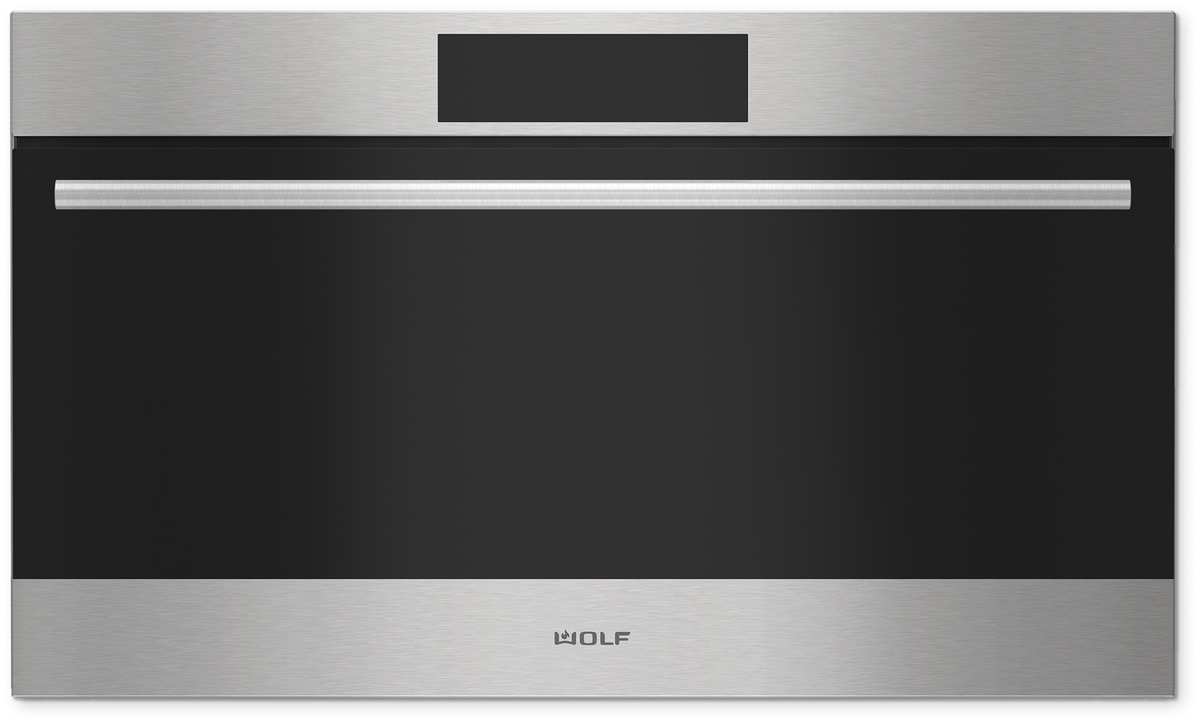
The E0 fault code on a Wolf M Series Speed Oven (models SPO24, SPO30, and their undercounter variants) is the most frequently diagnosed speed oven fault code in our service experience. When E0 appears, the speed oven continues to function as a convection oven but disables microwave and speed-cook modes entirely. Understanding why the oven responds this way — and what specifically causes E0 — removes the mystery from this fault and sets accurate expectations for the repair.
What E0 Means: A Protective Shutdown
E0 on the Wolf M Series Speed Oven indicates the cooling fan circuit has failed or the fan is not running at the required speed. This sounds like a simple fan problem — and mechanically, it often is — but the implications of a cooling fan failure in a speed oven are significant enough that the control system responds by disabling the appliance’s most powerful functions.
The Wolf Speed Oven uses an inverter-driven magnetron to generate microwave energy for microwave and speed-cook modes. The magnetron is a high-power vacuum tube device that generates substantial heat during operation — heat that must be actively removed by the cooling fan to keep the magnetron within its safe operating temperature range. Without adequate cooling airflow, a magnetron can overheat and fail within minutes of operation.
Magnetron replacement is one of the most expensive speed oven repairs — significantly more expensive than replacing the cooling fan that caused the problem. When the Wolf Speed Oven control system detects that the cooling fan is not running at the required speed, it immediately disables microwave and speed-cook modes as a protective measure. This is a deliberate software safety response designed to prevent magnetron overheating, not a hardware lockout. The oven correctly sacrifices its most impressive capabilities to protect the most expensive component.
Why Convection Mode Continues to Work with E0
One of the most common questions we hear about E0 is why convection oven mode continues to work when microwave and speed-cook modes are disabled. The answer lies in how the Wolf Speed Oven manages heat across different operating modes.
In convection mode, the oven uses a standard electric convection element and convection fan to heat the oven cavity — no magnetron is involved. The convection system generates significantly less concentrated heat than the magnetron, and that heat is distributed throughout the oven cavity rather than concentrated at a single component. The Wolf speed oven control allows convection mode to continue operating with E0 active because the risk profile is acceptable — the consequences of cooling fan failure during convection operation are manageable compared to the catastrophic component damage risk during magnetron operation.
The Three Common Causes of Wolf Speed Oven E0
E0 is caused by one of three component failures within the cooling fan circuit:
- Failed cooling fan motor (most common). The electric motor that drives the cooling fan has failed internally. The motor does not spin when power is applied to the fan circuit. A motor that hums without spinning is a characteristic sign of bearing seizure from lubrication breakdown — common in speed ovens installed in warm environments near the oven or steam oven. A motor that is completely silent (no hum) when activated has an open motor winding.
- Failed fan speed sensor (second most common). The Wolf Speed Oven uses a Hall effect sensor or similar speed-sensing device to monitor fan rotation speed. If this sensor fails, it sends no speed feedback signal to the control board — or sends an incorrect signal — causing the control board to believe the fan is not running even when the motor is functioning normally. E0 from a sensor failure is particularly frustrating because the fan may be audibly running, yet E0 remains active because the control board receives no confirmation of adequate speed.
- Wiring harness fault (less common). An open circuit in the wiring between the fan motor, speed sensor, or control board prevents the control from activating the fan or receiving fan speed feedback. Wiring faults can result from heat damage near the oven cavity, vibration-induced connector loosening over years of use, or insulation breakdown from thermal cycling.
What a Technician Does to Diagnose E0
Our technicians follow a systematic diagnostic approach for Wolf Speed Oven E0:
- Power reset first. Before accessing internal components, the technician attempts a full power reset (circuit breaker off for 60 seconds, restore power). If E0 clears and the speed oven operates in all modes through a test cycle, a transient fan fault was the cause.
- Access the cooling fan assembly. If E0 persists after reset, the technician removes the speed oven from its cabinet installation and accesses the service panel to reach the cooling fan assembly — typically located in the upper or rear section of the oven chassis, adjacent to the magnetron.
- Test fan motor directly. The technician applies voltage directly to the fan motor leads, bypassing the control board circuit, to determine whether the motor itself responds to power. A motor that spins normally under direct voltage but not under control board command points to a wiring harness or control board fault. A motor that does not spin under direct voltage has failed.
- Test speed sensor output. With the motor running under direct voltage, the technician checks the speed sensor output signal. A functional sensor generates a regular pulse output proportional to fan speed; a failed sensor generates no output or an erratic signal.
- Test wiring harness continuity. If both the motor and sensor test as functional, the technician tests each wire in the fan circuit for continuity to identify a wiring fault.
Can I Use My Wolf Speed Oven While Waiting for Repair?
With E0 active, you can use convection oven modes — Convection Bake, Convection Roast, and standard Bake — without restriction or risk. The convection system is independent of the cooling fan circuit that E0 monitors.
Do not attempt to use microwave or speed-cook modes with E0 active. The safety lockout exists to protect the magnetron from overheating damage. The speed oven’s control system prevents microwave activation with E0 active in normal operation — attempting to circumvent this protection would risk expensive magnetron failure that would significantly increase the total repair cost.
What to Expect From the Repair
Wolf Speed Oven E0 is resolved in a single service visit in the majority of cases. The most common repair — cooling fan motor replacement — typically takes 60–90 minutes. Fan motor assemblies for the SPO24 and SPO30 are stocked by our technicians as a common service part.
If the speed sensor rather than the motor has failed, replacement is similarly a single-visit repair. In all E0 repair scenarios, the technician confirms full speed oven function — including microwave and speed-cook modes — after the repair is completed, before the oven is returned to cabinet installation.
View our Wolf Speed Oven repair service or book a repair appointment with same-day availability.
Need a Wolf Appliance Repair?
Same-day service · Certified Wolf technicians · 30-day warranty on every repair.